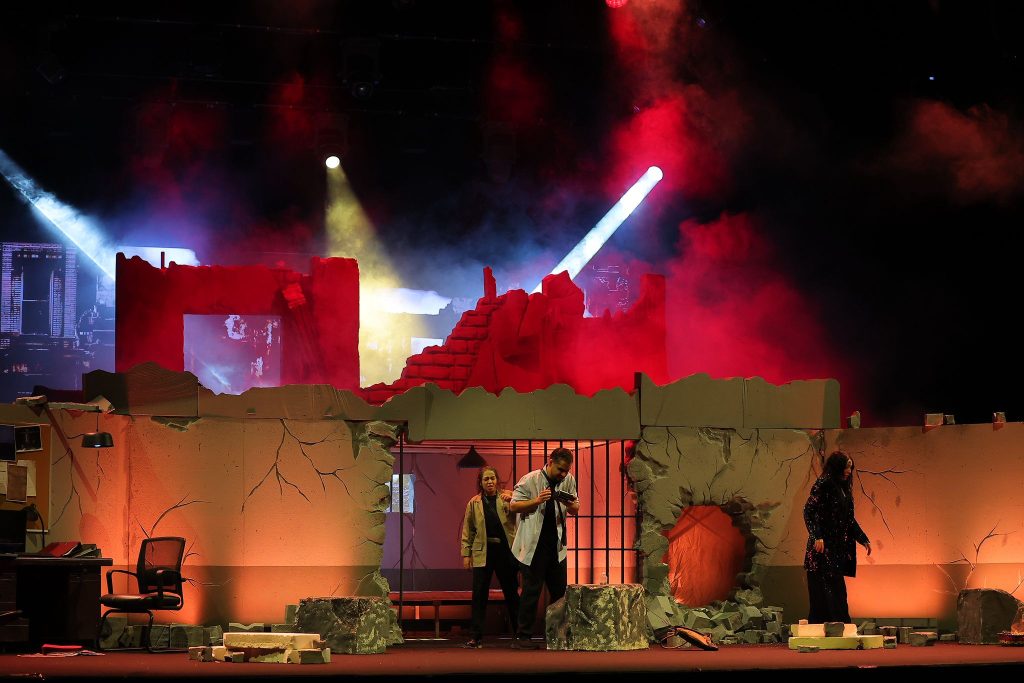
| The events of the 38th edition of the Doha Theatre Festival, organized by the Ministry of Culture, represented by the Theatre Affairs Center, were launched over a period of four days with the participation of community theatre groups.
The opening ceremony was held at Al Mayassa Theatre at the Qatar National Convention Centre QNCC, in the presence of Mr. Mubarak bin Abdullah Al Khalifa, Assistant Undersecretary for Cultural Affairs at the Ministry of Culture, along with a distinguished group of leading artists, theatre pillars, and creators, in addition to a large audience turnout that filled the theatre. On this occasion, Mr. Abdulrahman Al-Dulaimi, Director of the Culture and Arts Department at the Ministry of Culture, affirmed the historical and human value of the Doha Theatre Festival in its thirty-eighth edition, explaining that theatre is one of the oldest means of human expression. He noted that theatre has long held its place as the “Father of the Arts”, owing to its ability to reflect the depths of the human experience and transcends the boundaries of time and place. Historically, it has also been distinguished by its exceptional ability to keep pace with social and technological transformations without losing its identity or brilliance, achieving a difficult balance between preserving authenticity and embracing modernity. Al-Dulaimi stressed that theatre is no longer merely a classical mirror reflecting reality and daily concerns; rather, it has become an active element that contributes to shaping societal awareness and stimulating discussions on contemporary issues. He elaborated, saying that the role of theatre has expanded beyond observing the present to anticipating future challenges, which today imposes the necessity of reconsidering the roles of writers, critics, and artists as opinion leaders responsible for deconstructing reality and reformulating it through a conscious critical vision. For his part, Mr. Abdulrahim Al-Siddiqi, Director General of the Theatre Affairs Center, stressed the importance of the festival, noting that the Doha Theatre Festival, in its new edition, confirms that theatre is a renewable act that never runs dry. He expressed his aspiration that the performances and discussions of this edition would constitute a genuine space for celebrating beauty and inspiring ideas. Al-Siddiqi added that the true value of cultural festivals is not measured by the number of participants, but rather by their ability to continue getting their audiences and creators together, thereby securing their place in the cultural memory and ensuring the continuity of theatrical creativity from one generation to another. The festival began its first day with the theatrical performance Under the Rubble, presented by the Doha Theater Group. The play was written by Mr. Yasser Al-Hassan and directed by Mr. Faleh Fayez. The events of the performance take place inside a destroyed police station, raising an existential question about the fate of the individual when he finds himself stripped of institutional and social protection. The play reveals how human beings reproduce the laws of primitive authority in times of collapse, relying on the radio as the sole and distorted source of news, and on language as a means of falsifying reality. The performance concluded with an open ending that placed individual survival in confrontation with moral decline. Following the theatrical performance, a seminar was held in the presence of a number of interested attendees and critics. The seminar hosted Dr. Hanan Qassab and Mr. Fahd Al-Kuwari and was moderated by the media figure Mr. Mohammed Al-Hammadi. Dr. Hanan Qassab praised the directorial level of the performance and its atmosphere, which skilfully embodied the reality of war, noting that this edition is distinguished by artistic maturity and a clear visual vision. In contrast, Dr. Qassab criticized the absence of realism in certain scenes and elements of the scenography, particularly in reducing the woman’s interaction with the destruction and rubble of her home to merely wiping away dust, while the man remained isolated in his palace and preoccupied with marginal details that did not reflect the magnitude of the catastrophe surrounding him. For his part, Fahd Al-Kuwari stated that the dramatic structure faced certain procedural and artistic obstacles, pointing out that the themes presented discussed multiple dimensions ranging from women’s issues, political issues, and social issues, in addition to clear ideological aspects that recurred throughout the texts of the work. Tomorrow evening, Monday, the play The Dividing City will be presented by the Qatar Theatrical Group. The play is written by Talib Al-Dous and directed by Mohammed Youssef Al-Mulla. The production discusses a number of humanitarian and social issues within a symbolic framework that relies on expressive visual scenography. Coinciding with the activities of the thirty-eighth edition, the Theatre Affairs Center has published the Annual Festival Book, which highlights the most prominent activities and events organized by the Center during 2026. The publication also includes a gesture of tribute to four Qatari distinguished figures in theatre and the arts who passed away, leaving behind an enduring artistic legacy: Mr. Mohammed Al-Balam (artist), Mr. Talal Al-Siddiqi (director), Dr. Ahmed Abdulmalik (writer), and Mr. Khalifa Jamaan (artist), in recognition of their rich careers and their contributions to the cultural movement. It is worth noting that the Doha Theatre Festival represents one of the longest-standing and most distinguished theatrical platforms in the region. Its thirty-eighth edition this year further reaffirms its continuing pioneering role in enriching cultural life and presenting exceptional artistic experiences
|

Launch of the 38th Edition of the Doha Theatre Festival
22 June, 2026